
Six hands. One clear order.
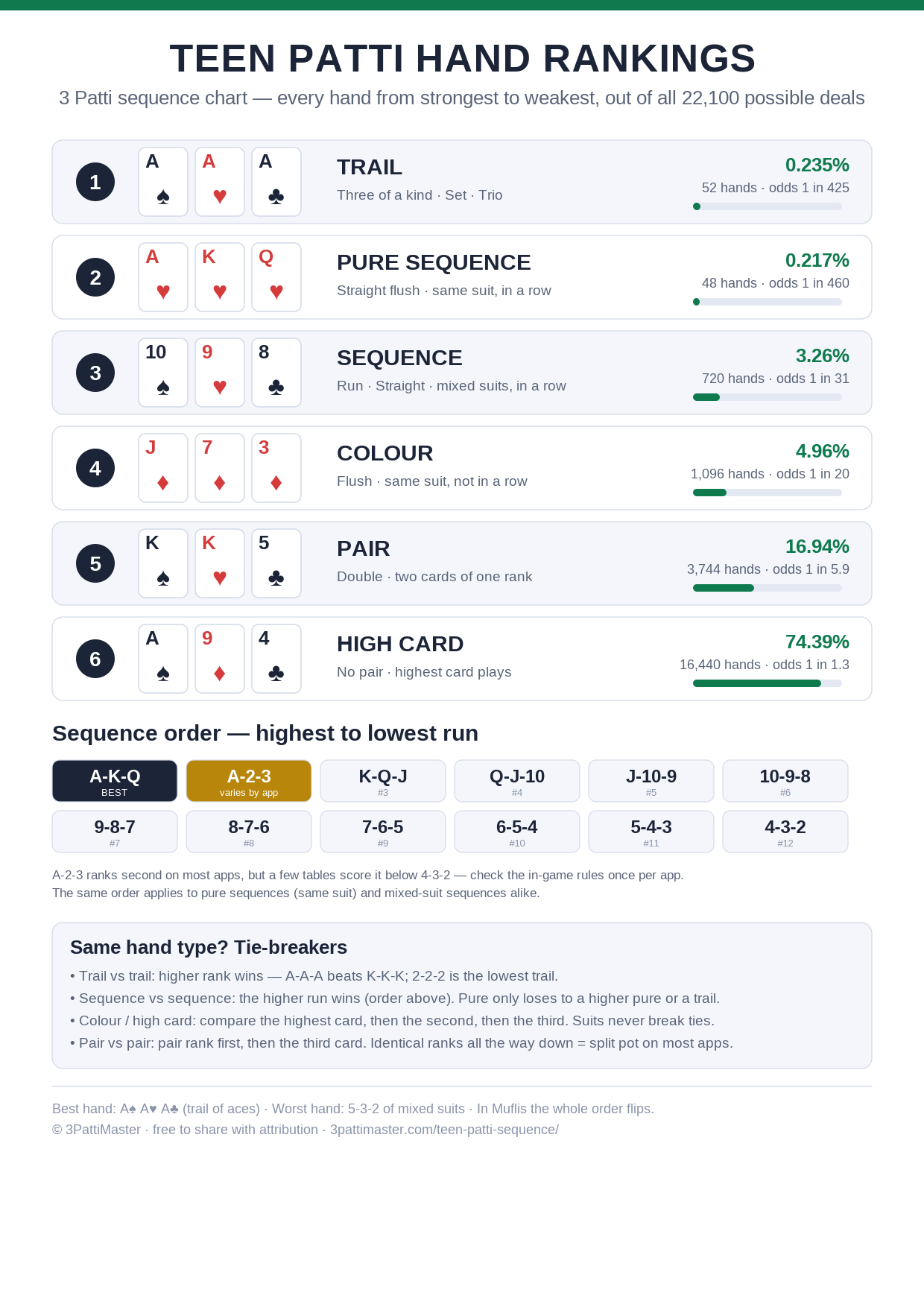
Classic Teen Patti compares the hand category first: Trail, Pure Sequence, Sequence, Colour, Pair and High Card. Use the explorer to connect each name with a three-card pattern.
Within a category, compare the ranks in the order defined by the table. The ace-run convention and final tie rule belong in your pre-game reading.
Six hands.
A clear order.
Select a hand to see its pattern. Learn the category first, then compare the ranks.
Three cards share one rank. Compare the rank when two trails meet.
Follow the round from deal to show
The round begins with the agreed boot, followed by three cards for each player. Play moves around the table through blind or seen turns, a chaal, a raise, a pack, and eventually a show.
A show compares the remaining hands. A round can also finish when a single player stays active. Use practice points while learning how the turn order and current stake work together.
Blind and seen: understand the current stake
Blind play keeps the cards face down; seen play follows a look at the hand. The table’s current stake and selected status determine the permitted contribution for the next turn.
For a practice example, use a current stake of 10 points. A table using the common 1×/2× blind and 2×/4× seen convention permits 10 or 20 blind points and 20 or 40 seen points. Read the table limits alongside the multiplier.
A worked hand, one comparison at a time
Player A holds K♠ K♥ 7♦. Player B holds A♣ J♥ 8♠. Player A has a pair and Player B has high card, so the pair wins under the classic hand order.
For two pairs, compare the pair rank first. K♠ K♥ 7♦ beats Q♣ Q♦ A♥ because the kings outrank the queens. When pair ranks match, compare the third card under the table’s tie rules.
Build a repeatable practice routine
Name the hand category before reading individual card ranks. Then explain your comparison aloud: category, rank, kicker and table convention.
Set a session duration, use practice points and review one unfamiliar rule after each round. This routine keeps learning focused and makes later comparisons easier.
Keep the hand chart close
Open the existing SVG chart for a detailed visual reference, or save the PDF for a printed learning sheet. Keep the selected table’s ace and tie conventions alongside the chart.
Follow the source
- Classic hand categoriesTeenPatti Royale developer help
A few good questions
What is the classic Teen Patti hand order?
Trail, Pure Sequence, Sequence, Colour, Pair and High Card. Compare the category first, then the card ranks using the selected table’s ace and tie conventions.
What is the difference between sequence and pure sequence?
Both use consecutive ranks. A pure sequence shares one suit; a sequence uses mixed suits.
What should I read before a practice round?
Read the hand order, ace convention, blind and seen multipliers, table limits and the rule for a show or sideshow.